Latin & Muslim
Latin and Muslim: faith, language and belonging
You can be Latin and Muslim. Being Latin describes heritage and cultural identity; being Muslim describes faith. Learning about Islam does not require you to erase your family history or become Arab. There is room to explore faith while valuing your language, family ties and heritage.
Words and meanings
God, Dios, Allah: one meaning
Dios in Spanish, God in English and Allah in Arabic are different words in different languages for the one God. Allah is not only a Muslim word: Arabic-speaking Christians in the Middle East also say Allah when they speak of God, and Catholics in Malta, whose language is close to Arabic, pray to Alla. Many Arab families who settled in Latin America from the late 19th century were Christian. Chile’s Palestinian community, estimated at more than 500,000 people, is one of the largest outside the Middle East, and its own federation says most of its members are Christian.
Sources Society of Saint John Chrysostom, 2009(opens in a new window); BBC News Mundo, 2021(opens in a new window)
Allah, God and ilāh
Allah is the Arabic word for God, or Dios in Spanish. The Arabic word ilāh means a god or deity. A common explanation connects Allah with al-ilāh, ‘the God’. The difference between ‘God’ and ‘a god’, or Dios and un dios, can help explain the distinction, but Arabic has no capital and lowercase letters.
Sources Hassim and Cole-Adams, 2010(opens in a new window); Oxford research archive (being verified)(opens in a new window)
A familiar word: ojalá
A familiar Spanish word carries a connection to Arabic. The Royal Spanish Academy traces ojalá to Andalusi Arabic wa šá lláh, glossed as ‘and God has willed’. Today, Spanish speakers use ojalá to express a strong wish or hope. Its history is a small example of contact between languages.
More words from Arabic
Many everyday Spanish words came from Arabic. The Royal Spanish Academy traces azúcar (sugar) to Andalusi Arabic assúkkar, aceite (oil) to azzáyt and almohada (pillow) to almuẖádda. Portuguese shares the same history: açúcar, azeitona (olive) and almofada (cushion) also come from Arabic.
Sources RAE dictionary(opens in a new window); Infopédia, “almofada”(opens in a new window); Correio Braziliense, 2026(opens in a new window)
Shared history, honestly told
From 711 to 1492, Muslim-ruled territories existed in parts of the Iberian Peninsula, with borders and rulers changing over time. Muslims, Christians and Jews lived in these societies. There were periods of exchange and cooperation, alongside unequal status, conflict and persecution. This history helped shape a shared cultural inheritance, but it was not eight centuries of uninterrupted peace.
Sources Gerber, NEH, 2019(opens in a new window); Safran, 2013(opens in a new window)
Living side by side
In al-Andalus, Christians and Jews were protected communities. They kept their own judges, courts and laws, practised their faith, and paid a tax, the jizya, instead of serving in the army. There were limits too: new churches could not be built, and most positions of power were closed to them. Even so, for long periods Muslims, Christians and Jews lived, worked and worshipped side by side.
Sources Safran, 2013(opens in a new window); Britannica, Mozarab(opens in a new window); Mozarabs, Wikipedia(opens in a new window)
Toledo: translating the world’s learning
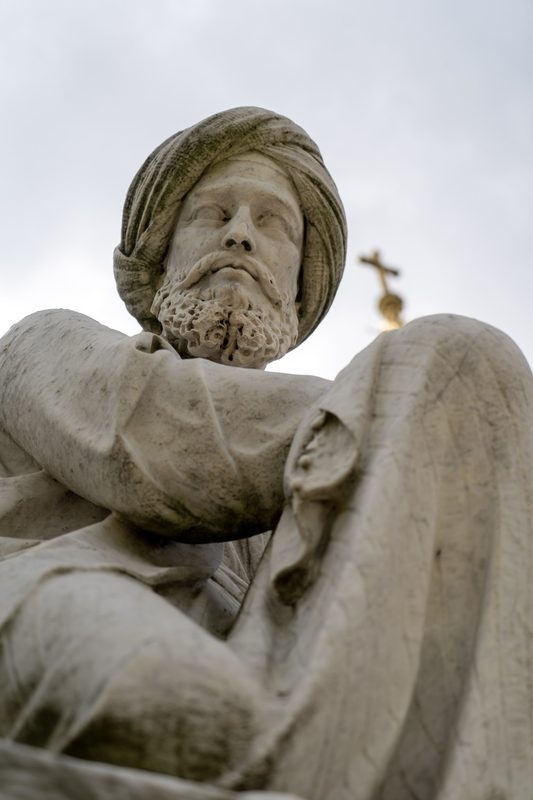
In the 12th century, Toledo became a centre for translating books from Arabic into Latin, often with Jewish scholars working alongside Christian translators. Through them, the commentaries of Ibn Rushd (Averroes) of Córdoba became the main guide to Aristotle in Europe’s universities, and the greatest Christian thinkers of the age, such as Thomas Aquinas, engaged closely with his ideas and with those of Ibn Sīnā (Avicenna). Scholars from as far as England travelled to Toledo to learn.
Sources Stanford Encyclopedia of Philosophy(opens in a new window); Daniel of Morley, Wikipedia(opens in a new window)
References
- Real Academia Española and ASALE, Diccionario de la lengua española, entry “ojalá”. https://dle.rae.es/ojal%C3%A1(opens in a new window) Accessed 22 October 2026.
- Eeqbal Hassim and Jennet Cole-Adams, Learning from One Another: Bringing Muslim Perspectives into Australian Schools, National Centre for Contemporary Islamic Studies, University of Melbourne, 2010 (PDF). https://arts.unimelb.edu.au/__data/assets/pdf_file/0009/1882566/LFOA.pdf(opens in a new window) Accessed 22 October 2026.
- Oxford University Research Archive, discussion headed “Allāh = the God (al-ilāh)?” https://ora.ox.ac.uk/objects/uuid%3A977914cb-d783-4949-aed4-f0b6c2eaa562/files/m34f1a166246ec073a79d42ea09d9cc1a(opens in a new window) Accessed 22 October 2026.
- Jane S. Gerber, “Ornament of the World” and the Jews of Spain, National Endowment for the Humanities, 2019. https://www.neh.gov/article/ornament-world-and-jews-spain(opens in a new window) Accessed 22 October 2026.
- Janina M. Safran, Defining Boundaries in al-Andalus, Cornell University Press, 2013. https://academic.oup.com/cornell-scholarship-online/book/23953(opens in a new window) Accessed 22 October 2026.
- Society of Saint John Chrysostom, The use of the word ‘Allah’ by Christians in history and today, 11 November 2009. https://ssjc.uk/use-of-word-allah-by-christians-in/(opens in a new window) Accessed 22 October 2026.
- BBC News Mundo, Cómo llegó Chile a tener la mayor comunidad de palestinos fuera del mundo árabe, 3 June 2021 (republished by T13). https://www.t13.cl/noticia/nacional/bbc/como-llego-chile-a-tener-la-mayor-comunidad-de-palestinos-fuera-del-mundo-arabe(opens in a new window) Accessed 22 October 2026.
- Real Academia Española, Diccionario de la lengua española, entries “azúcar”, “aceite” and “almohada”. https://www.rae.es/drae2001/az%C3%BAcar(opens in a new window) Accessed 23 October 2026.
- Bruno Vaz, Palavras de origem árabe que você fala todos os dias, Correio Braziliense, 13 June 2026. https://www.correiobraziliense.com.br/cbradar/palavras-de-origem-arabe-que-voce-fala-todos-os-dias/(opens in a new window) Accessed 23 October 2026.
- Mozarabs, Wikipedia (citing Wolf, Coope and Bulliet), consulted 23 October 2026. https://en.wikipedia.org/wiki/Mozarabs(opens in a new window) Accessed 23 October 2026.
- Dag Nikolaus Hasse, Influence of Arabic and Islamic Philosophy on the Latin West, Stanford Encyclopedia of Philosophy, revised 3 December 2025. https://plato.stanford.edu/entries/arabic-islamic-influence/(opens in a new window) Accessed 23 October 2026.
- Daniel of Morley, Wikipedia: an English scholar who studied in Toledo in the 12th century, consulted 23 October 2026. https://en.wikipedia.org/wiki/Daniel_of_Morley(opens in a new window) Accessed 23 October 2026.
- Infopédia, Dicionário da Língua Portuguesa, entry “almofada”: from Arabic al-mukhaddâ, “cushion; pillow”. https://www.infopedia.pt/dicionarios/lingua-portuguesa-aao/almofada(opens in a new window) Accessed 23 October 2026.
- Encyclopaedia Britannica, Mozarab: Christians in Muslim Spain “ruled by their own officials” under a Visigothic legal code, with their own bishoprics, churches and monasteries. https://www.britannica.com/topic/Mozarab(opens in a new window) Accessed 23 October 2026.
Read next
Keep reading
Who is Mary in Islam?
The only woman named in the Qur’an, with a chapter of her own.
Islam in the Americas
1492, West African Muslims, the Malê revolt and Arab families in Latin America.
Who is Jesus in Islam?
The Messiah, born without a father, who will return.